When Do You Take Profits? Take-Profit Orders vs. Ratcheting Sell Stops
A subscriber wrote in with a question worth answering in public: how do you know when to take profits on a recommendation — and should you just set a take-profit order when you place the buy?
Short answer: a take-profit order is one legitimate way to exit, a ratcheting sell stop is another, and which one you use is your call. They fail in opposite directions, and the whole decision comes down to which failure you'd rather live with.
Here's the mechanical picture, then the tradeoff, then what our own process does with it.
A Take-Profit Order Is a Limit Order
"Take-profit" is a label, not a separate order type. Mechanically it's a sell limit order: you name a price, and if the market reaches it, the order sells at that price or better.
Suppose you bought at $10 and you'd be satisfied taking a 20% gain. You set the sell limit at $12. Nothing happens while the price is below $12. If it gets there, you're out at $12 or better.
(The $10 and $12 figures are purely illustrative. They are not a recommendation for any ticker, any price level, or any target.)
On the sell side, the two exit orders sit on opposite sides of the current price, and it's worth fixing this in your head before you touch an order ticket:
| Sell-side exit | Sits where | Fires when |
|---|---|---|
| Sell limit (take-profit) | Above the current price | Price rises to your target |
| Sell stop | Below the current price | Price falls to your level |
One is you deciding in advance where the good news is enough. The other is you deciding in advance how much of a move against you is enough. Both are placed before anything happens, and both then run without you watching.
If any of that order-type vocabulary is new, start with Buy Stop / Sell Stop Strategy Explained — it covers what each order is, how it triggers, and how to place one at your brokerage. This article picks up where that one stops: not how to place the exit, but which exit to place.
The Tradeoff, Both Directions
Here's the honest version, because both choices cost you something.
A take-profit limit caps your upside at the number you picked. Set it at $12 and $12 is what you get — including on the days the price runs well past $12 without you. You chose the exit before you had any information about how far the move would go, and the order has no way to reconsider.
A ratcheting sell stop gives back the distance between the high and your stop. Say you trail a stop 10% under the price and move it up as the price rises. The price reaches $15; your stop is sitting at $13.50. If the move ends there, you exit at $13.50 — a 35% gain on your $10 entry, where the limit order would have handed you 20% and left the rest on the table. That's the whole argument for the stop in one line: you didn't have to guess where the move would end. You just paid $1.50 to find out it had.
Run the same tape past the limit order and you get the mirror image. It sells at $12 and you bank 20% — and then you watch the thing print $15 without you, which was 50% you decided in advance not to take.
(Every figure here is arithmetic on made-up numbers, for showing how the two order types behave. Not a recommended trail distance, target, ticker, or price, and not a result anyone obtained.)
And the ratchet has a second cost the limit doesn't: a stop can take you out on a shakeout that then recovers. A price dip that clips your stop and immediately reverses leaves you out of a position that kept going. A limit order sitting above the market is indifferent to that dip.
So the scoreboard is not "one of these is better." It's:
- Limit — certainty about the price, no certainty about how much of the move you leave behind.
- Ratcheting stop — you stay in as long as the trend does, and you pay for that by never exiting at the high, and by occasionally being knocked out early.
There's no arithmetic that resolves this. It's a question about which regret you tolerate better, and that's genuinely yours to answer.
What Our Process Does With It
Our recommendations are built around the stop side. That isn't a claim that stops are superior — it's a description of what the methodology is doing.
The published TIPS methodology puts it plainly: "As long as the bar stays green, let the trend be your friend and ratchet up the sell stop price. Eventually that green bar color will turn red which will trigger the sell stop, and then the process repeats itself." (The TIPS methodology)
The strategy is built to catch a security coming off its lows on the way in and coming off its highs on the way out. That is a price-action approach: the exit is defined by what the price does, not by a profit target chosen up front. A fixed take-profit target would answer a question the strategy never asks.
Which is also why our recommendations specify a ticker, a direction, and a level — and don't specify a profit target. There isn't one to specify.
The criteria, on a real chart
Here's the same idea with the criteria marked up, on a daily chart of TQQQ from January 2026 through early August. Roy annotated this one himself.
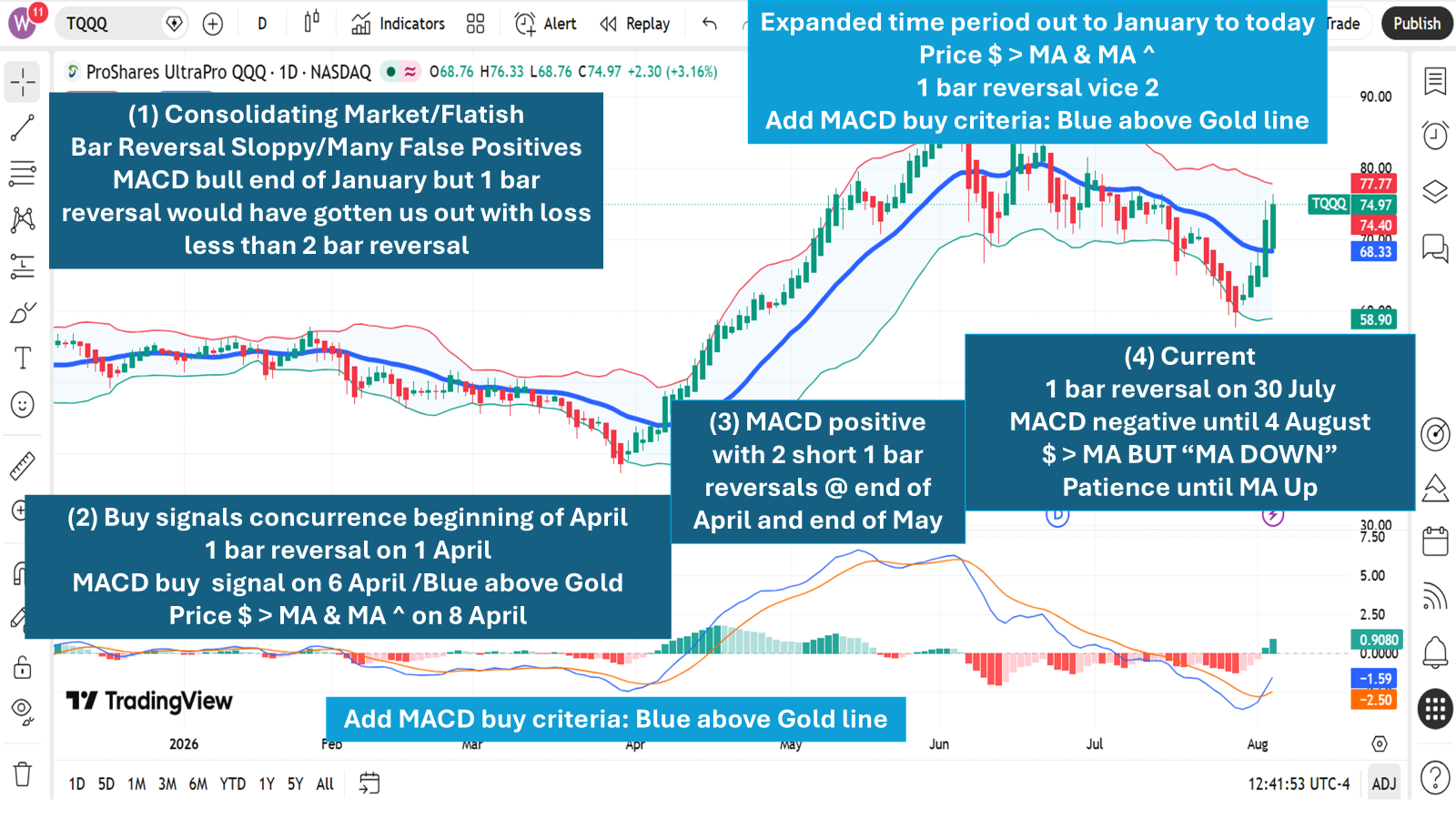
Four things to see in it:
- A flat, chopping market gives sloppy signals. Through the first quarter the price grinds sideways and the reversal signal fires repeatedly without meaning much. False positives are what a consolidating market produces. This is the stretch where the process says wait.
- Criteria confirming together is the setup. In early April the reversal, the MACD crossing, and price above a rising moving average all arrive within about a week of each other. One criterion alone isn't the signal. Concurrence is.
- The trend runs, and brief reversals interrupt it. Two short one-bar reversals show up at the end of April and end of May inside the larger move. This is exactly the ratchet-versus-limit question made concrete: a trailing stop rides through what a fixed target would have closed out at the first number it liked.
- Today, the criteria disagree — so the answer is wait. Price is above the moving average, but the average itself is still pointing down. That's not a setup. It's patience.
The fourth point is the one worth sitting with, because it's the least satisfying. Most of what a criteria-driven process produces is not yet.
A practical note on the ratchet. Moving a stop up is an action somebody has to take. Your brokerage may offer a trailing-stop order type that moves it for you automatically; labels and availability vary, so check your own platform. Otherwise it's a manual cancel-and-replace, which on most order tickets is a thirty-second job — the mobile walkthroughs include editing an existing stop at Fidelity, Schwab, and Robinhood. If you'd rather place the exit at the same moment as the entry, that's a conditional order.
Why We Don't Tell You Which One To Use
Choosing between a take-profit limit and a ratcheting stop is a preference about your own exits. It isn't part of what a subscription delivers, and we're not going to pretend otherwise: it depends on your goal and on what you'll actually be comfortable holding through.
What we do deliver is the recommendation — ticker, direction, level, published on the Stock Actions track's daily cadence, before the next session. You place every trade yourself at your own brokerage. investment.tips never accesses your accounts. The exit order you attach to a position is yours to choose, and both of the ones described here are ordinary order types available at any brokerage that allows daily trading.
When the Answer Is "No Trade"
One thing worth saying, because it's the part that surprises people: a process built on multiple criteria spends a lot of days not buying anything.
When some of the criteria line up and others don't — price has moved but the trend hasn't turned, or the momentum reading hasn't confirmed — the answer is no trade. Not a smaller position, not an early entry. No trade. That's the mechanism working, not the mechanism being slow, and it's the same discipline that later makes the ratchet worth trusting on the way out.
That's not hypothetical. It's why we passed on UOPIX in the TSP Mutual Fund Window track this week — it cleared some of the criteria and failed the last one, the same "MA still pointing down" condition marked as point 4 on the chart above. Nothing dramatic happened. We just didn't buy. (The TSP Mutual Fund Window track issues allocation recommendations as needed — usually about 6–7 times a year. You make every allocation change yourself inside your own TSP account.)
Patience is a position.
Frequently Asked Questions
Is a take-profit order the same as a limit order?
Yes. On the sell side, a take-profit order is a sell limit order. You name a price above the current market price, and if the market reaches it the order sells at that price or better. Some platforms label the field "take profit" and some label it "limit" — mechanically it's the same order.
Should I set a take-profit order at the same time I place my buy stop?
You can, and some brokerages support it directly through a conditional order that submits the exit automatically once the entry fills. Whether you should is a personal preference, not something investment.tips recommends. A take-profit limit locks in your exit price and caps your upside at that price; a ratcheting sell stop keeps you in while the trend continues but exits below the high and can be triggered by a temporary dip. Neither is the correct answer for everyone.
What's the difference between a sell limit and a sell stop?
They sit on opposite sides of the current price. A sell limit is placed above the current price and fires when the price rises to your target, selling at that price or better — price certainty, but no certainty the order ever fills. A sell stop is placed below the current price and fires when the price falls to your level, then typically executes as a market order at the next available price — execution certainty once triggered, but no certainty about the exact fill price.
What is a ratcheting or trailing sell stop?
It's a sell stop that gets moved upward as the price rises, so the distance between the price and your exit stays roughly constant. Some brokerages offer a trailing-stop order type that does this automatically; otherwise it's a manual cancel-and-replace on the existing stop order. Labels and availability vary by platform, so confirm what your own brokerage supports.
Do investment.tips recommendations include a profit target?
No. Stock Actions recommendations specify a ticker, a direction, and a price level for the stop order. The methodology defines exits by price action rather than by a fixed profit target, so there's no target to publish. Subscribers who prefer to exit at a set gain can attach their own take-profit limit; that choice is theirs and isn't part of the recommendation.
Will I be notified when to sell?
Stock Actions publishes recommendations on its daily cadence, including sell-side recommendations and the levels that go with them. You execute every trade yourself at your own brokerage; investment.tips never accesses your accounts and cannot place, modify, or cancel an order for you.
This is not investment advice. All investment decisions are your responsibility. Past performance does not guarantee future results.